Top Signs You Need Garage Door Service – Don’t Ignore These
A garage door that takes three seconds longer to open than it did last month isn’t aging gracefully. It’s a spring under increasing stress, and the change in speed is the door telling you something. The signs that matter most are the ones homeowners talk themselves out of: the little grind, the slight tilt, the opener that pauses before it moves. If you’d rather not climb a ladder to investigate, call (866) 989-9389 and we’ll take a look.
What are the first signs a garage door needs service?
The earliest signs are changes in sound, speed and alignment, not a full breakdown. A door that used to glide and now hesitates, or one that sits a little crooked at the bottom, is giving you notice. In our experience across Greater East Side, most homeowners wait until the door stops moving entirely. By then a cheap adjustment has usually turned into a same-day repair call.
Here’s what to listen and look for first:
- A single loud bang from above the door. That’s usually a torsion spring breaking. It’s not subtle, and it’s not something to test by hand.
- Grinding or popping that repeats. Grinding points to rollers, tracks or bearings. A rhythmic pop often means a cable is jumping or a drum is worn.
- Loose rattling. This one is often cosmetic – a bracket or hinge working loose. Worth snugging up, rarely an emergency.
- The door reversing or stopping halfway. That’s a safety sensor or a travel-limit issue, and it usually needs a proper adjustment.
The distinction matters because it tells you how fast to act. Cosmetic noise can wait a week. Grinding, popping and bangs shouldn’t. Springs and cables are under high tension, and a trained technician is the right person to touch them.
Why does an uneven garage door get worse over time?
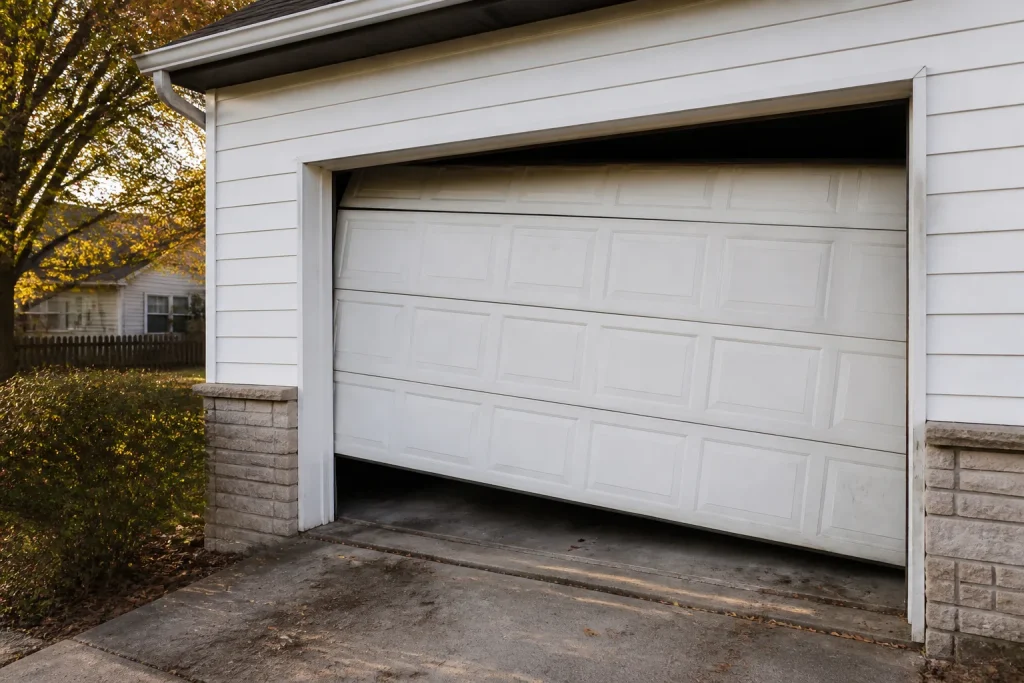
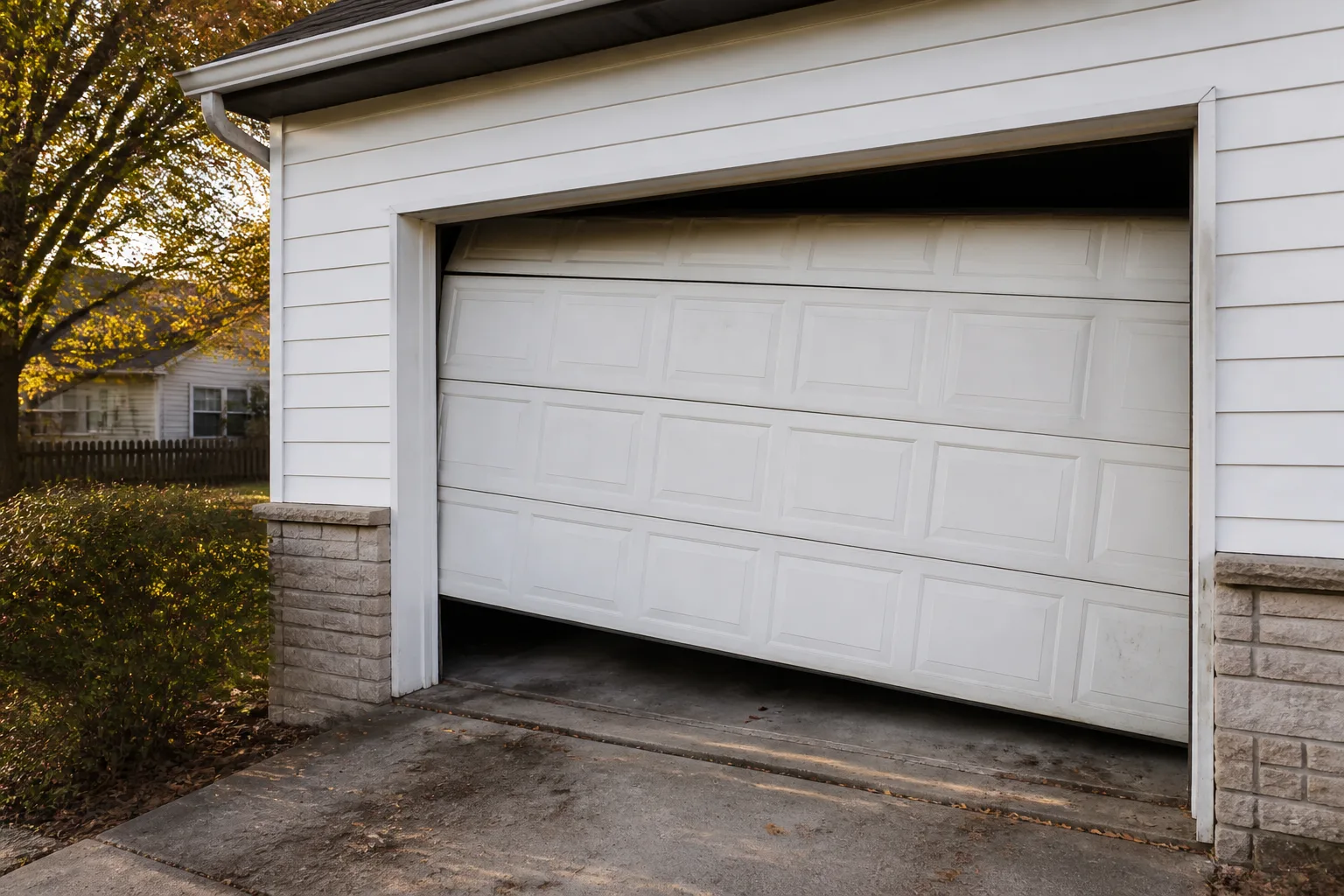
An uneven door is almost always a cable or spring tension problem, and it compounds. When one side carries more load than the other, the imbalance stretches that cable further and wears that spring faster. The gap that starts at half an inch doesn’t stay at half an inch.
Watch for these in Greater East Side homes:
- One corner of the door sitting visibly lower when closed.
- A gap along one side of the bottom seal while the other side is tight.
- The door binding or scraping in the track on one side only.
- An opener that strains on the way up but sounds normal coming down.
Left alone, an uneven door puts sideways pressure on the tracks and puts extra strain on the opener motor. What starts as a tension adjustment turns into cables, rollers and eventually opener repairs. Catching it early is the difference between a quick tune-up and a bigger bill. This is exactly the kind of thing our garage door repair service handles every week.
How do you check if your garage door springs are losing tension?
You can check spring balance in about 30 seconds without touching a spring or a cable. Disconnect the opener using the release cord so the door moves by hand, lift it to about halfway, and let go gently. A healthy door holds roughly where you left it. A door that sinks on its own is telling you the springs are losing tension.
Do this test with the door closed first and keep your hands clear of the hinges and the gap between sections. Then note:
- Door drops from halfway: springs are weakening and the opener is compensating. It’s working harder than it should, and that’s when motors burn out.
- Door is very hard to lift by hand: springs may be over-tensioned or a cable is bound. Stop and call a pro.
- Door feels loose or wobbly side to side: could be rollers, hinges or track alignment rather than springs.
What you should never do is adjust the springs yourself. Torsion springs and their cables hold enough force to cause serious injury, and that work belongs with a technician who has the right winding bars and training. Our technicians have up to 15 years of experience with high-tension components, and we treat that part of the job with the respect it deserves.
What do worn weatherstripping and bottom seals tell you?
Weatherstripping and bottom seals wear out on a schedule, and how they fail tells you something about the door itself. A bottom seal that’s cracked or flattened lets in water, drafts and pests, but it’s a simple swap. A seal that’s crushed on one end and untouched on the other points to an alignment problem underneath.
In Greater East Side, where freeze-and-thaw cycles work on seals and panels all winter, we see this pattern often. Check for:
- Brittle or torn rubber along the bottom edge. Normal wear. Easy to replace.
- Daylight visible under a closed door. The door may not be seating evenly, or the seal has compressed flat.
- Rust streaks or water staining on panels. Moisture is getting past the seal and sitting against the door.
- Dents, cracks or separation between panels. Structural, not cosmetic. A compromised panel weakens the whole door and can bind in the track.
Panel damage is the one homeowners most often dismiss. A cracked section flexes under load, which throws off the door’s balance and puts pressure on everything else. If a panel is compromised, it’s worth having it looked at before it becomes a track or opener problem.
Why is a slow opener usually a mechanical problem, not an electrical one?
A slow or hesitant opener is usually fighting mechanical resistance, not losing power. When springs weaken, rollers seize or tracks bind, the motor has to work harder to move the same weight. The opener isn’t failing – it’s overworked, and replacing it won’t fix the underlying drag.
That distinction changes your repair bill. A motor replacement on a door with bad springs solves nothing and the new unit wears out fast. Diagnosing the resistance first is the honest way to spend money. This is where brand fluency helps: whether your opener is a LiftMaster, a Chamberlain or an older Craftsman, the diagnosis follows the same logic, and we work on all of them without a compatibility runaround.
Signs the opener is straining rather than failing:
- The door moves slowly but the motor sounds normal.
- The opener struggles on the way up more than the way down.
- Lights dim briefly when the motor starts.
- The door reverses for no clear reason during travel.
If the motor itself is grinding, clicking or dead, that’s a different job. Our garage door opener repair covers both the electrical side and the mechanical drag behind it. We work on nearly every major brand, so there’s no runaround about compatibility.
When should you call a pro instead of waiting?
Call a pro the moment you hear a bang, see the door hanging unevenly, or find the door won’t move at all. Those are the signs that escalate fast, and they’re the ones where a short call now prevents a much bigger repair later. Springs, cables and anything under tension are not homeowner jobs. A trained technician handles those safely, and we’d rather you didn’t test your luck with a loaded torsion spring.
The two-to-four week window is real. A door that’s sluggish today is usually a door with a weakened spring or a binding track, and those get worse with every cycle. A small adjustment call early is far cheaper than an emergency repair after something snaps. Emergency service is part of what we offer, not a surprise upcharge, and we’re a single-trade shop – garage doors are all we do, which means we do them right.
Related services in Greater East Side: if your door is past repair, our garage door installation covers new doors from Clopay, Amarr, Wayne Dalton and Raynor. For the full range of what we handle, see Garage Door Repair Greater East Side.
The Bottom Line
Most garage door failures announce themselves weeks before they happen. A slower open, a grinding sound, a slight tilt, a seal that’s crushing on one side – these are the early warnings, and acting on them is the cheapest repair you’ll ever make. Cosmetic rattles can wait. Grinding, popping, bangs and uneven movement can’t. If you’re in Greater East Side and need help, Garage Door Repair Greater East Side offers free estimates – call (866) 989-9389. We’re open Sunday through Friday, 7am to 7pm, and closed Saturday.
Frequently Asked Questions
A door that opens more slowly or unevenly than it used to. That change usually points to weakening springs or a tension imbalance, and it’s the sign homeowners most often dismiss as normal aging. Call (866) 989-9389 for a free estimate if you notice it.
Yes, treat it as one. A single loud bang usually means a torsion spring has snapped, and the door should not be operated until a technician checks it. Call (866) 989-9389 and we’ll get it looked at.
No. Torsion springs and cables are under high tension and can cause serious injury if handled without the right tools and training. Leave spring work to a trained technician. Call (866) 989-9389 for a free estimate.
We’re closed Saturday and open Sunday through Friday, 7am to 7pm. If your door fails, call (866) 989-9389 and we’ll book you for the next available slot – estimates are free.
Written by the team at Garage Door Repair Greater East Side.
Need Garage Door Help?
Call Garage Door Repair Greater East Side - the local pro we connect you with is licensed and insured, here with fast after-hours help in Greater East Side.
(866) 989-9389